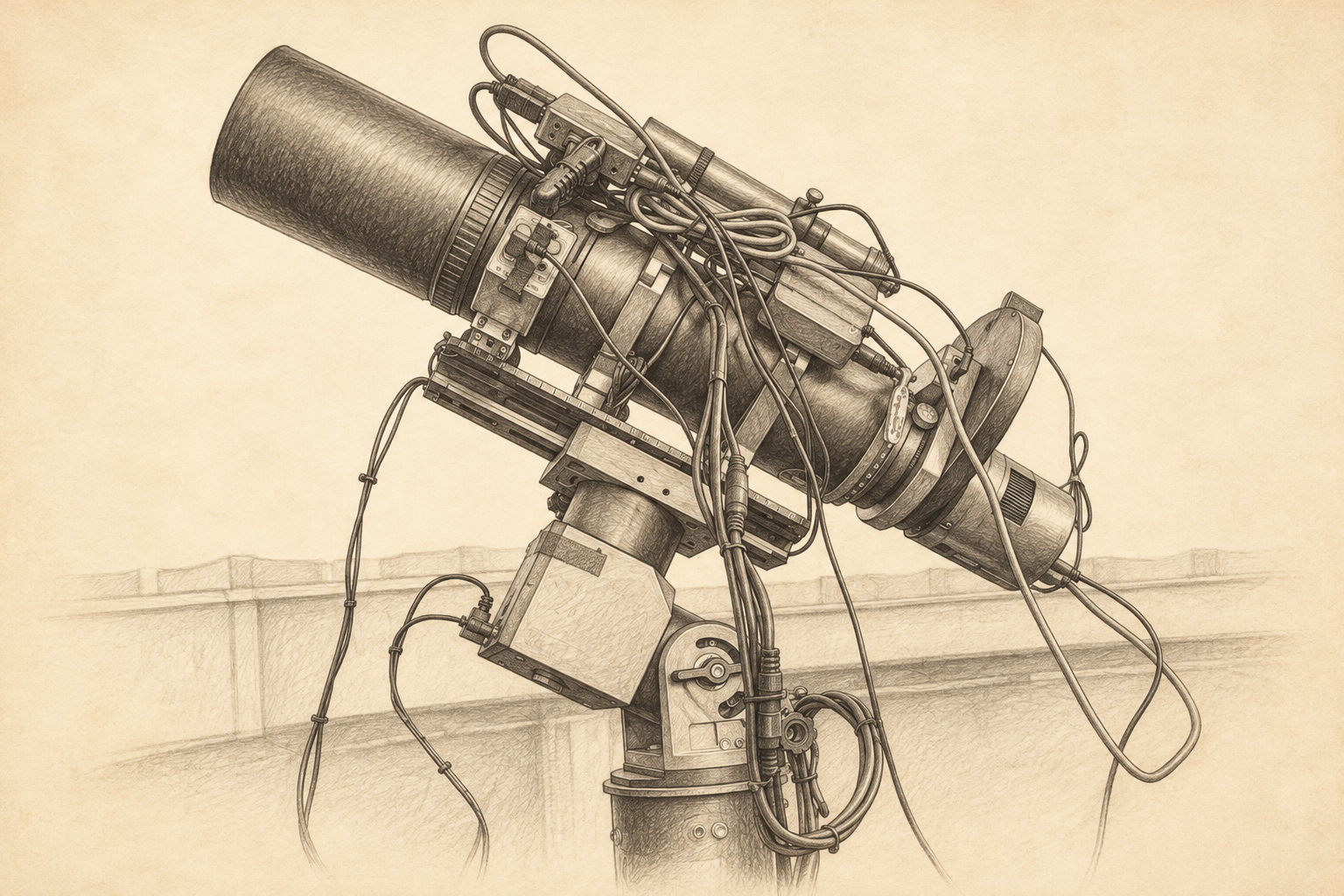
The observatory as a system
At Starfront Observatories I operate a remote deep-sky imaging system. Its optics, control software, network, recovery path, and image archive work together through an unattended night.
The imaging train
Wide-field optics
William Optics RedCat 91: 91 mm aperture, 448 mm focal length, f/4.9 apochromatic refractor.
Monochrome capture
Cooled ZWO ASI6200MM Pro: full-frame, 61.2 MP, 3.76 μm pixels. A seven-position electronic filter wheel carries LRGB and 3 nm sulfur, hydrogen, and oxygen filters.
Tracking, focus, and framing
A ZWO AM5N mount, UniGuide 32 and ASI220MM guide camera, electronic focuser, and camera-angle adjuster keep the equipment working without anyone at the pier.
One sequence controls the night
Point and center
NINA coordinates the devices through ASCOM. ASTAP solves the star field and the sequence corrects pointing.
Focus and guide
Autofocus establishes focus. PHD2 watches a guide star and corrects tracking during exposures.
Adapt through the night
The sequence changes filters, dithers, refocuses, and can perform a meridian flip before resuming.
Close and preserve
The camera warms, the mount parks, and the image data is prepared for transfer to the NAS.
Designed for distance
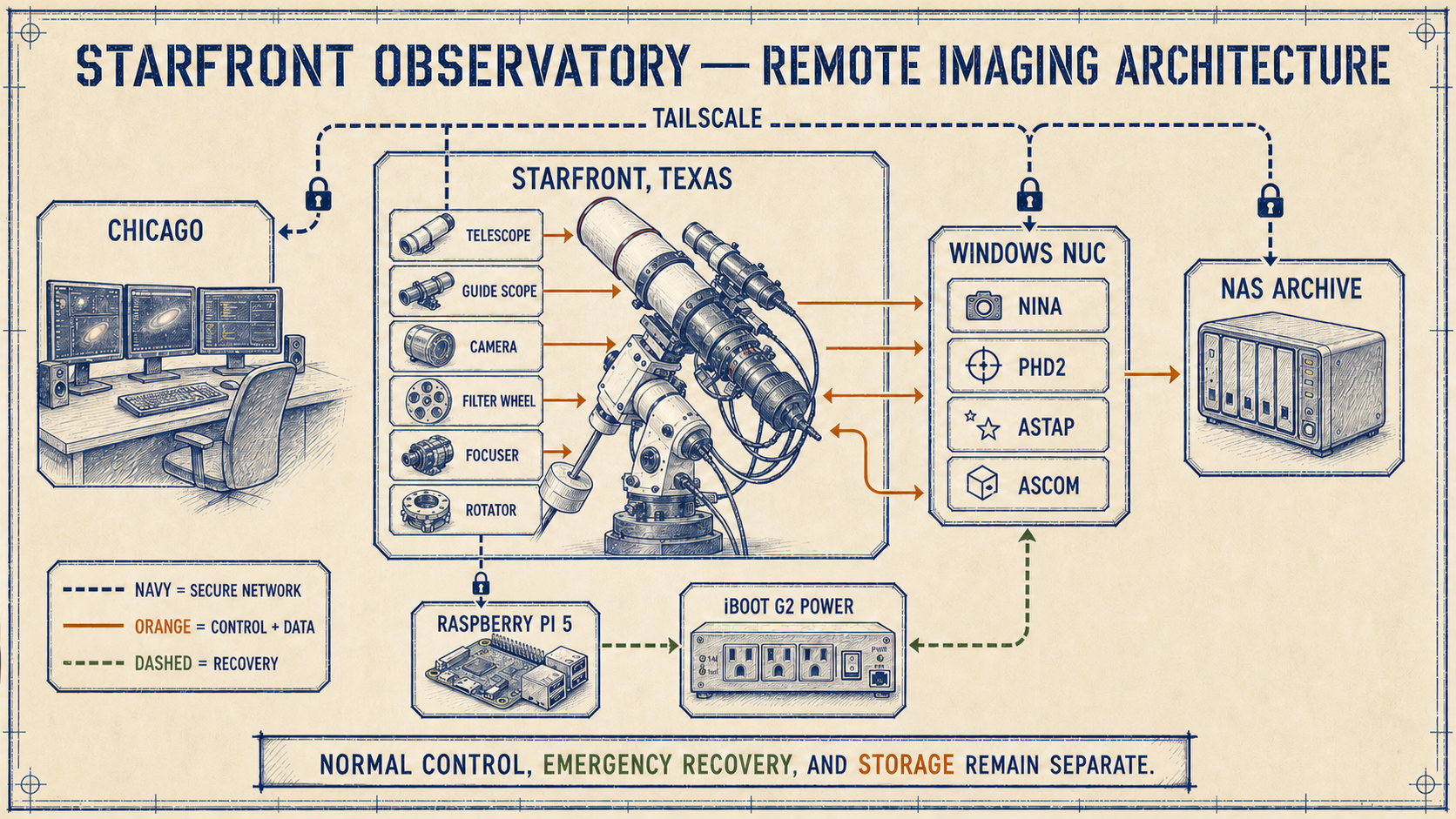
Tailscale connects Chicago, the observatory computer, the recovery Pi, and storage over a private network. Remote desktop provides the working interface.
The Raspberry Pi is separate from the Windows control path and can reach the network power switch when the NUC is unresponsive. The acquisition computer is not the archive: frames move to NAS storage for retention and processing.
My own planning and processing software
Starfront ranks targets for a night, tracks equipment and exposure goals, reviews FITS frames, builds conventional or 2× drizzle masters, and carries images through a persistent processing workflow.
The original workflow used Codex to manage processing up to drizzle masters before continuing in tools such as PixInsight. The software has grown into an end-to-end planning, review, stacking, and processing environment.
Visit the image gallery →